Sunday, April 28, 2013

Workshop: Toblerone


This group, we made a social media campaign aimed at promoting the Toblerone candy. We are tasked with making a social media advertising campaign which engages younger generations to this classic candy.
Our group went with a "Toblerone Moment" idea, where the consumer can engage with other Toblerone fans with instagram, vine, and twitter.

Since all 3 of the social media rely on twitter as the primary pusher, its important to work in small snippets, using things like the hashtag #tobleronemoment to mark vine videos recorded, mark instagram photos, as well as providing trends within twitter itself.


Vine is a new video recording social media trend that takes short and creative 30s videos that forces users to  film cleanly and get straight to the point. the best of the videos will be voted on to claim the top Toblerone moment, allowing the consumers to gain Toblerone merchandise while further advertising for Toblerone.

Interrupting Advertising

Most advertising today is filtered out by a savvy consumer. Even now, I use a combination of Tivo, if I ever do sit down to watch the TV, or I use online ad filtering software that eliminates almost all forms of advertisements online. Even if they don't use another 3rd party service to do the commercial filtering for them, they can tune out, mute or otherwise divert attention from most forms of advertising that has been pushed upon them since childhood. 

Although this form of advertising has been slowly added to existing online sources  the age of the commercial break in broadcast television is coming to a close. I literally don't know any close friend who sits down to watch TV anymore, instead they vouch for either on demand entertainment or online programming.\

TV is indeed the elephant in the room. Its still a vast industry that is in slow decline. This scares the living piss out of larger media corporations and they will struggle to keep pace with consumer demands and still retain full control. Most pirating happens with programs/networks unwilling to provide easy and affordable access to programs, which is why titles like HBO's "Game of Thrones" is one of the most pirated shows ever. Because it requires an active cable subscription, which most users don't have/want in the first place in order to watch one show. Large media companies will be on the chopping block within a decade if they don't adapt for a internet driven media industry.


Workshop: Housewarming Product

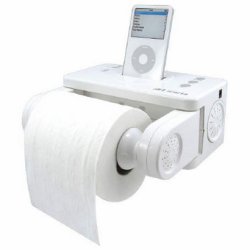
Our group was charged with making a ridiculous product seem like the perfect gift for a house warming party, we were assigned to the toilet paper roll ipod docking station.


Our media outlets were radio and tv commercial:

RADIO: 
Sound Effect: faucet running in background, toilet roll, hearing noises outside (lawn mowers, etc.)
MVO: I wish there was a solution for this noise! Lets try out moms new gift!
(walks over to close, opens box, places on roll, noises getting ever louder)
MVO: this should do the trick! (turns on sooth music, all sounds cuts but music)
ahhh, relaxing!

Narrator: New introducint a toilet roll docking station for the ipod!. The answer to ALL your bathroom needs! Its the ipod that lets you ROLL it it! (fade out music)


Got Ethics


I was able to join about halfway through the seminar on 4/16, admittedly because I needed the extra credit. The discussion entitled "Got Ethics?" is a play off the Got Milk? slogan which ties both he idea of advertising and the idea of ethics together in one cheesy slogan. Every speaker I heard in the discussion were ethical issues they had all encountered one way or another throughout their career. All had varying degrees of how they would handle subjects or ideas they had found to be touchy subjects, such a political or subversive advertising. The prescription ad bit I found interesting because of environment surrounding the doctors and patients, as the consumer themselves cant get a hold of the product. I never realized it was such a taboo everywhere besides the US to be marketing drugs like commercial products in the US. This seems both good and bad for the pharmaceutical industry, which has become a hotly debated industry in recent years.

Creative Advertising, now with 80% less suck!

In my opinion, the only way advertising come off and not being cheesy are creative bits that don't fit the standard advertising mold. Creative advertisements are not only effective promotions of brands or products, but also works of art in their own right. I used to watch a TV show that was nothing but streamed ads that were well above the standard commercials. Creative advertisements for an array of products both stood out for cinematography, graphics, narration, or anything else that deserved a spotlight as a creative ad. Unfortunately this creative video service was cancelled and I cannot quite recall the name of it exactly. (foxfire?)


The point is, creative advertising can be works of art, blurring the lines between fine and commercial art. One of my favorite more recent examples comes from Toyota, as a projection mapping sculpture project, showcasing how green and clean new Toyota cars are. It not only show cases the advertising campaign that the manufacturers intend to go for, a clean and green automobile, but it also showcases the technological and artistic progressions that Toyota sponsors and engineers.

An extraordinary 3D projection mapping event, for an extraordinary car. Relive the story of a car which recycles energy as it drives – the Toyota Auris with Hybrid Synergy Drive. Filmed on location in Shoreditch, London on 22 September 2010.

Workshop: The Typewriter, Coming Soon!

This last Monday, our group worked with tying to re-imagine the typewriter campaign to advertise to the new generation, bringing the typewriter out of the obsolete and into the hip, new, now. Unfortunately our target audience was seniors so we couldn't do any of those things and instead focused on what made a type writer a classic instrument for use for elder people. Seniors and in need of a professional writing utensil that doesn't use any of that new fangled stuff called electricity and the computing boxes attached to it! 

We kept our advertising channels as Television commercials, newspaper adverting and radio advertising, avoiding most of the social media outlets that older generations are not plugged into. Rife with nostalgic references, our advertising would tap into not only the classic noises, motions and use of the mechanical typewriter, but also the practical uses of such a device in an age enslaved to their devices battery power. All were straight up modeled after mac commercials, taking a minimalist approach to a vintage/classic vibe of the typewriter. The campaign itself not only brings out the strong sense of nostalgia, but also the bold new vision for using the typewriter in an all digital age.

We stuck to our main slogan for most advertisements, "No batteries, No Distractions, Just Your Own Thoughts". We would highlight the sounds and tactile satisfaction of using such and analog machine, as well as downplay the need for anything else, like wifi or other useless features when trying to make a simple word document. Formatting issues and other problems associated with using word processors are contrasted against the simple movements of moving the paper on the machine itself, conveying the devices intuitiveness and immediacy.

Nostalgia Advertising

 What are some of the major advantages and disadvantages of nostalgia marketing? 

For products fortunate enough to drawn upon memories of nostalgia for their own brand, they are emphasize reliability, timelessness, refinement and more. All these ideas are connected to nostalgia, vintage, or otherwise classic products. 

By re-promoting the brand as a classic endeavor  it also makes consumers feel like they are buying quality as well as sharing memories of others who might have been used to using the brand in the past. So nostalgia can play both as a catalyst for more customers to sign on because of older associations with the product or other traditions they might want to become apart of, and it can promote the strength of the brand to the older community, further solidifying their choice in the same product they have used for years.

Are there some products or brands which this strategy may not be successful?

For products who want to be seen as cutting edge or current, this nostalgic market could come back as looking antiquated and aged. Some campaigns go as far to render their products looking obsolete in an attempt to harvest a nostalgic feeling. This happened to SONY electronics in 2009 when they marketed their WALKMAN MP3 player, which tried to tie in the classic WALKMAN brand to their newer MP3 players. Not only was the product poorly received  mainly because all its features were archaic alongside the leading competitor, the ipod, but the products advertising came off as out of touch and highlighted how slow electronic giants were willing to adapt to new trends. With most phones being used a MP3 players, SONY never was able regain the large market share they had with the original WALKMAN in the 80s.


Jeep Workshop

The typical jeep is defiantly aligned at the sporty/SUV yuppies that need a larger car but still visions themselves as "active". The challenge today was to marker the jeep for a target audience of over 50. In order to do this, we need to identify what this older groups needs from a vehicle.

Reliability: first and foremost is reliability, you want your audience to feel like this might be the last car they need to buy, so anything that highlights the Jeep brand durability and reliable record is a big deal

Safety: Your frail audience is concerned about their aging bodies, so another main aspect is vehicle safety  Not only personal safety, but also for their younger family members.

Comfort: The older generation is tired of being cramped up in budget cars, show off the main parts of the vehicles interior and control. The smooth ride and comfortable inside will be reassuring. Not only will they be able to handle whatever they world throws at the car, but they will do it in comfort.


For our TV ad: An older gentleman is cleaning out the house, when he comes across an old journal of his memories from when he was younger. He then sits and reads the book a bit closer, noting a scribbled promise between him and his friends that they will travel across the US when they return from war. With some light chuckles, the man decides to make contact over the phone with these old friends, who then meet up together, exchanging handshakes and hugs that old friends would. They then all pile into a open top jeep, and they drive off, acting young and realizing their childhood dream.


Harley Davidson


Question 1: Do you believe brand communities like Harley-Davidson result in greater involvement with the brand?

Brand are much more than just names or recognition of the product, but are also long lasting consumer communities and cults that can be tapped into and used to further promote the products themselves. Most companies covet a product ecosystem that would be self perpetuating and self advertising within a large group in society. But creating such an intimate relationship between product and consumer takes a lot of time, refinement and most importantly, personal connections for individuals that promotes a sense of brand identity that goes along with the product and the people who use it.

Question 2: What elements of the Posse Ride do you believe enhance the meaning of the brand for the riders?

Interactions between other consumers and parts of the brand creates a sense of comradery. Other people who are using their products because they are simply great nostalgic products that all tie into the same image. Sharing goals and other experiences with other riders not only strengthens the sense of community with the product itself, but also acts as an advertisement itself, begging others to adopt this new walled garden that Harley put up. These can also be used time and time again for statistical information/promotion from within the company as well as a tied in shared experience that consumers can share with other family/friends who might be apart of the Harley Davidson community.

Question 3: Should Harley-Davidson get more involved in the ride or would that dilute the ride's meaning to the participants?

While organizing more events for community purposes seems like its always a good idea, the fact is that with a brand like Harley, it goes against the image to put together larger commercialized spectacles. The free spirit  intimate nature of using Harley bikes and close group riding would be tarnished if it were to loose the sense of freedom that would accompany a large and structured event. However, this can work for some brands that can fit into such event images. For other events to be successful like the posse ride, you need smaller scale and targeted events or community projects that don't interfere with the image of the lone biker that has nothing but himself and the road.

Question 4: In addition to experience such as the Posse Ride, what other ways could Harley increase involvement in the brand?

I think a project in the same vein as Nike's running share project would work out well for Harley. Destinations or paths that needed to be taken/data collected from photos/smartphone apps that contribute to a larger project without being a constant nuisance on a biking road trip. A collage of the united states, photos of bikes, routes taken by bikes, classic moments from biking in the US, all this data is easily collected with smartphones these days, and a giant collaborated project within the Harley community could not only instill feelings of a deeper and richer Harley community, but also tap into older  photos or past history of the brand and the people who used it.


Enviormental Campaign

  
State Water Resources Control campaign at reducing urban runoff started their campaign about 10 years ago in the early 2000's. They are aiming to provide more awareness regarding urban runoff throughout California, but in southern California in particular. They claim that the home values are only high in southern California because of the beautiful ocean they run along. 


Most notable part of their campaign are the various signs and curb paint that claim the storm drains “Drain to the Ocean”, creating a direct link between the storm drain on the ground and the ocean the people visit. This is modified even locally to create an even more visceral connection (drains to Morro Bay Estuary, drains to Guadalupe River, etc) Their campaign has been quite successful in urban runoff awareness proliferation over the years, a well done environmental campaign that cheaply provided mass awareness as well as a practical message to home owners and developers.

Tide Workshop

I was part of creating a back story with my group based on a Tide commercial we had chosen. While all of this is faction, most of it derives from the core messages being put forth in the commercial, both subtle and not so subtle:

Hellen loves Tide
Hellen wakes up in the morning at about 7:00 am, hops out of beautifully white sheets to make breakfast and lunches for her family. When making breakfast she throws something together quickly, a bowl of cereal and some fruit. Then starts to prepare lunches for her three children, two boys and one girl. The lunch includes a peanut butter and jelly sandwich, carrot sticks, and a small baggie of pretzels. 


Although she may be in a rush, she never forgets to leave an encouraging note in their lunch box to get the kids through the rest of their day.  Then, she helps her kids get ready for school, placing their brightly colored and clean clothes on them and kisses her husband goodbye wearing his Then, in her Honda Odyssey mini van, she drops the kids off at school. Next, she goes to Safeway and picks up groceries for the week and a bottle of Tide. Then goes home, puts some laundry in the washer, and cleans the house. Then, she goes on a run with their families chocolate Labrador, Charlie. 


Then comes home and starts to prepare dinner. Around 2:30, Hellen leaves to go pick up the kids and then brings them all to soccer practice, then around 5:00 picks them up. Because the kids worked so hard at practice, they all got grass stains on their uniforms; causing her to have to do more laundry when she comes home. Then while the kids are doing their homework, Hellen finishes cooking dinner, when her husband comes home. Then the family eats dinner together, then watches a family show where each of them are wrapped in a blanket that smells so wonderful because of the Tide detergent. After the show, it is off to bed for the family where they climb into their clean sheets and fall asleep.

Failed Products

There are countless examples of failed products within the market today. It almost seems like the very nature of the industry to demand more exuberant and added features that don't always play into consumer tastes. But even growing up, I remember many tangible examples of failed products without even bringing the boom and bust of the information age.


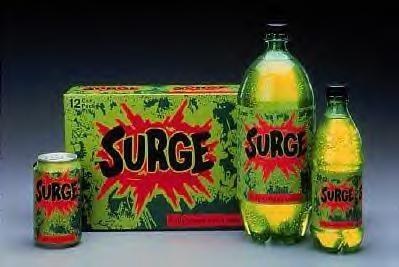
There was an agressive marketing campaign set up coca-cola for a new product called SURGE, a slight twist on the traditional mountain dew styled drink. Initially high sales were driven by a vast marketing campaign aimed at sending the softdrink to an extreme sports crowd. I remember getting it with friends as a kid, no doubt way too much caffine and sugar for our adolesent selves, the product then quickly lost steam and was discontinued in 2003. Apparently it has garnered quite the cult following and is still popular in Norway, where the recipe for the drink originated from. It wasn't as extreme of an end as some other sodas, like JOLT, which was pulled from shelves because of the FDA, but it did proliferate most schools and younger groups much quicker, becoming an instant cult classic.

Monday, March 11, 2013

Playhouse Commercial

 This playhouse commercial highlights the pitfalls of stereotyping, this “dream home” consists of the boy playing the role of home provider and the little girl played the role of the homemaker. Today's more clever campaigns could turn the entire thing on its head and provide the same message yet give it a shock value targeted at a more mature and hip young crowd, although the might be going for the more traditional home demographic, in which case the commercial could have some sort of cute appeal. However, I see commercials like this becoming more and more rare as the overall population is not so keen on traditional domestic roles anymore.

Gender Stereotypes

 
Gender profiling is still highly prevalent in must of todays advertising for one simple reason, SEX SELLS. It always has and always will as long as its target audience is humans. However, I think that there is more and more sexual innuendos in advertising themselves today. 


With America in general becoming less prude and more open to non traditional family roles, theres much more public talk of sex, advertisers are becoming more daring in order to garnish sales. While not necessarily a bad thing, they must learn where the current “line they cannot cross” is when it comes to this type of stereotyping as there can be a harsh backlash if the advertisement pushes itself too far past the comfort zone of the targeted demographic.


Racial Stereotypes

 
Racial stereotyping is a byproduct of the human need to categorized and make connections within unknown communities. Buying into the racial stereotypes is not so much as a malicious intention, but rather an unpleasant side effect. Advertisers capitalize on that idea, making associations between products and popular known stereotypes. 


Obviously, most advertising stays clear of negative racial stereotypes, but that doesn’t mean it wont creep into profiling glasses on asian models, nikes on african americans, etc. While advertising in general could use a bit more diversity, associations between cultural groups and products or services still do exist, and you don’t want to be sending your consumer the wrong or conflicting messages.

Monday, February 18, 2013

Understanding Semiotics

Semiotics is much more than what its defined as. Although its known as the study of signs and symbols, its encompasses a variety of fields, from Lingustics to Psycology. Its an extention of the human psyce projected into universal symbols.


Navigating these symbols is a part of being human. We use them in day to day activities, such as traffic signs or labels, but there is another subconscious world that people pick up upon in advertising that most people are unaware of. Colors evoke emotions, signs associate feelings, and advertising use these as tools to elevate an idea for their product.

 For example, the ketchup example above shows a bottle sliced and stacked, very reminiscent of a freshly sliced tomato. we know this because of color, texture, and the iconic tomato stem at the top of the bottle. This is only a fraction of all subconscious ideas going through consumers minds.


Tuesday, February 5, 2013

Its Brandtastic!

Branding is more than just the name on a product. It encompasses everything your product wants to be, represents or even how the product is appealing. Styles, formatting, even which avenues of distribution all contribute to your overall "brand image". This image permeates all aspects of life when people are in contact with advertising, which is all the time these days.
Branding servers more than just as your products PR, but also as a quality assurance to the wary customer. Most of the time, people wont care what is being offered or added, and go for the impulse buy of a brand they know what to expect from. The "next big thing" is rarely tried and even rarer for a consumer to switch. Typical consumers want that peace of mind of what to expect from the product they buy.

Guest Speaker: Dietmar Dahmen

Our guest speaker, Dietmar Dahmen, was a brilliant and eccentric presenter! I have had to sit through many speakers who might feel passionate about their work, but are disconnected from the audience, or even artist that didn't even seem that interested in presenting at all. Even the typical troupe of using a powerpoint to make a presentation was used in an unconventional way, quickly sliding around his points, using the powerpoint more like a image narrative interwoven into his speaking. 
His views on advertising and how the new technology and revolutionized the field in new and exciting ways drive home the idea that you must be ever evolving, changing, adapting to the consumers. Because even though your the big brand now, its can easily become a unchanging giant left behind like so many companies have before. Touching upon many subjects surrounding technological change, Dietmar makes a point of staying agile and willing to take risks in an ever changing marketing landscape.
 

Monday, January 28, 2013

My name is Scott Blackwell. I am a digital media art student at San Jose State University. This post are my thoughts about advertising in general, and how it plays a roe within my life.

While I don't think advertising is inherently evil, its uses have been dubious in pop culture over the past few decades. We always see it shoved in our faces, interrupting what we were watching in order to pitch something to buy. While its being used less in this manner and more cleverly employed, the commercial is still a key component of an advertisers repertoire.

I have seen beautiful commercials and other clever methods of using advertising without being disruptive or cliche, and those are the products I tend to gravitate towards With how easy it is for everyone to use advertisements across the internet, and demographics shifting from primarily TV media to primarily internet media, advertising is going to learn to adapt to survive or become a victim of market selection themselves.