Sunday, April 28, 2013

Workshop: Toblerone


This group, we made a social media campaign aimed at promoting the Toblerone candy. We are tasked with making a social media advertising campaign which engages younger generations to this classic candy.
Our group went with a "Toblerone Moment" idea, where the consumer can engage with other Toblerone fans with instagram, vine, and twitter.

Since all 3 of the social media rely on twitter as the primary pusher, its important to work in small snippets, using things like the hashtag #tobleronemoment to mark vine videos recorded, mark instagram photos, as well as providing trends within twitter itself.


Vine is a new video recording social media trend that takes short and creative 30s videos that forces users to  film cleanly and get straight to the point. the best of the videos will be voted on to claim the top Toblerone moment, allowing the consumers to gain Toblerone merchandise while further advertising for Toblerone.

Interrupting Advertising

Most advertising today is filtered out by a savvy consumer. Even now, I use a combination of Tivo, if I ever do sit down to watch the TV, or I use online ad filtering software that eliminates almost all forms of advertisements online. Even if they don't use another 3rd party service to do the commercial filtering for them, they can tune out, mute or otherwise divert attention from most forms of advertising that has been pushed upon them since childhood. 

Although this form of advertising has been slowly added to existing online sources  the age of the commercial break in broadcast television is coming to a close. I literally don't know any close friend who sits down to watch TV anymore, instead they vouch for either on demand entertainment or online programming.\

TV is indeed the elephant in the room. Its still a vast industry that is in slow decline. This scares the living piss out of larger media corporations and they will struggle to keep pace with consumer demands and still retain full control. Most pirating happens with programs/networks unwilling to provide easy and affordable access to programs, which is why titles like HBO's "Game of Thrones" is one of the most pirated shows ever. Because it requires an active cable subscription, which most users don't have/want in the first place in order to watch one show. Large media companies will be on the chopping block within a decade if they don't adapt for a internet driven media industry.


Workshop: Housewarming Product

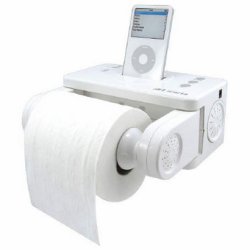
Our group was charged with making a ridiculous product seem like the perfect gift for a house warming party, we were assigned to the toilet paper roll ipod docking station.


Our media outlets were radio and tv commercial:

RADIO: 
Sound Effect: faucet running in background, toilet roll, hearing noises outside (lawn mowers, etc.)
MVO: I wish there was a solution for this noise! Lets try out moms new gift!
(walks over to close, opens box, places on roll, noises getting ever louder)
MVO: this should do the trick! (turns on sooth music, all sounds cuts but music)
ahhh, relaxing!

Narrator: New introducint a toilet roll docking station for the ipod!. The answer to ALL your bathroom needs! Its the ipod that lets you ROLL it it! (fade out music)


Got Ethics


I was able to join about halfway through the seminar on 4/16, admittedly because I needed the extra credit. The discussion entitled "Got Ethics?" is a play off the Got Milk? slogan which ties both he idea of advertising and the idea of ethics together in one cheesy slogan. Every speaker I heard in the discussion were ethical issues they had all encountered one way or another throughout their career. All had varying degrees of how they would handle subjects or ideas they had found to be touchy subjects, such a political or subversive advertising. The prescription ad bit I found interesting because of environment surrounding the doctors and patients, as the consumer themselves cant get a hold of the product. I never realized it was such a taboo everywhere besides the US to be marketing drugs like commercial products in the US. This seems both good and bad for the pharmaceutical industry, which has become a hotly debated industry in recent years.

Creative Advertising, now with 80% less suck!

In my opinion, the only way advertising come off and not being cheesy are creative bits that don't fit the standard advertising mold. Creative advertisements are not only effective promotions of brands or products, but also works of art in their own right. I used to watch a TV show that was nothing but streamed ads that were well above the standard commercials. Creative advertisements for an array of products both stood out for cinematography, graphics, narration, or anything else that deserved a spotlight as a creative ad. Unfortunately this creative video service was cancelled and I cannot quite recall the name of it exactly. (foxfire?)


The point is, creative advertising can be works of art, blurring the lines between fine and commercial art. One of my favorite more recent examples comes from Toyota, as a projection mapping sculpture project, showcasing how green and clean new Toyota cars are. It not only show cases the advertising campaign that the manufacturers intend to go for, a clean and green automobile, but it also showcases the technological and artistic progressions that Toyota sponsors and engineers.

An extraordinary 3D projection mapping event, for an extraordinary car. Relive the story of a car which recycles energy as it drives – the Toyota Auris with Hybrid Synergy Drive. Filmed on location in Shoreditch, London on 22 September 2010.

Workshop: The Typewriter, Coming Soon!

This last Monday, our group worked with tying to re-imagine the typewriter campaign to advertise to the new generation, bringing the typewriter out of the obsolete and into the hip, new, now. Unfortunately our target audience was seniors so we couldn't do any of those things and instead focused on what made a type writer a classic instrument for use for elder people. Seniors and in need of a professional writing utensil that doesn't use any of that new fangled stuff called electricity and the computing boxes attached to it! 

We kept our advertising channels as Television commercials, newspaper adverting and radio advertising, avoiding most of the social media outlets that older generations are not plugged into. Rife with nostalgic references, our advertising would tap into not only the classic noises, motions and use of the mechanical typewriter, but also the practical uses of such a device in an age enslaved to their devices battery power. All were straight up modeled after mac commercials, taking a minimalist approach to a vintage/classic vibe of the typewriter. The campaign itself not only brings out the strong sense of nostalgia, but also the bold new vision for using the typewriter in an all digital age.

We stuck to our main slogan for most advertisements, "No batteries, No Distractions, Just Your Own Thoughts". We would highlight the sounds and tactile satisfaction of using such and analog machine, as well as downplay the need for anything else, like wifi or other useless features when trying to make a simple word document. Formatting issues and other problems associated with using word processors are contrasted against the simple movements of moving the paper on the machine itself, conveying the devices intuitiveness and immediacy.

Nostalgia Advertising

 What are some of the major advantages and disadvantages of nostalgia marketing? 

For products fortunate enough to drawn upon memories of nostalgia for their own brand, they are emphasize reliability, timelessness, refinement and more. All these ideas are connected to nostalgia, vintage, or otherwise classic products. 

By re-promoting the brand as a classic endeavor  it also makes consumers feel like they are buying quality as well as sharing memories of others who might have been used to using the brand in the past. So nostalgia can play both as a catalyst for more customers to sign on because of older associations with the product or other traditions they might want to become apart of, and it can promote the strength of the brand to the older community, further solidifying their choice in the same product they have used for years.

Are there some products or brands which this strategy may not be successful?

For products who want to be seen as cutting edge or current, this nostalgic market could come back as looking antiquated and aged. Some campaigns go as far to render their products looking obsolete in an attempt to harvest a nostalgic feeling. This happened to SONY electronics in 2009 when they marketed their WALKMAN MP3 player, which tried to tie in the classic WALKMAN brand to their newer MP3 players. Not only was the product poorly received  mainly because all its features were archaic alongside the leading competitor, the ipod, but the products advertising came off as out of touch and highlighted how slow electronic giants were willing to adapt to new trends. With most phones being used a MP3 players, SONY never was able regain the large market share they had with the original WALKMAN in the 80s.